Business problem
Many dermatology practices rely on web forms and front-desk staff to collect intake information, triage visit reasons, verify insurance, and manage follow-up. That workflow creates avoidable delays, repetitive data entry, and limited visibility into operational bottlenecks.
Observed constraints
- Manual intake data capture across multiple fields and steps
- Administrative burden on small clinic teams
- No orchestration layer connecting intake, scheduling, and follow-up
- Limited reporting on time loss, patient throughput, and conversion
Why it matters
- Longer intake times can reduce capacity and create patient friction
- Manual re-entry increases error risk and staff fatigue
- Unstructured workflows make scaling difficult for small and growing practices
- Without analytics, process improvement becomes guesswork
Opportunity identified
The outreach campaign was not treated as generic prospecting. Each clinic was evaluated as a workflow modernization opportunity, with CRM notes used to document operational pain points, estimated business value, and a proposed automation pathway.
Intake
Replace fragmented patient information capture with structured digital forms and pre-visit workflows.
Operations
Reduce front-desk workload by automating confirmations, reminders, and intake routing.
Analytics
Capture operational data for dashboards that support decisions on staffing, throughput, and process quality.
Proposed solution architecture
A lightweight, integration-ready workflow was proposed to move clinics from manual intake to a measurable, automation-friendly operating model.
Digital intake capture
Patient submits structured intake data through web or tablet-based forms.
Cloud storage layer
Form submissions are stored in AWS for secure persistence and downstream processing.
Workflow orchestration
Apache Airflow coordinates validation, routing, notifications, and task sequencing.
Downstream integration
Data can flow into CRM, EHR, scheduling, or reporting systems as the clinic matures.
Operational analytics
Dashboards surface intake efficiency, admin workload, and throughput trends.
Estimated business impact
The case study used a conservative small-clinic model to estimate value. The goal was to show that even a single-location practice can justify a meaningful workflow automation engagement when intake inefficiency is addressed.
| Category | Estimated impact | Business meaning |
|---|---|---|
| Intake processing time | 40-60% reduction | Faster patient onboarding and less manual handling by staff |
| Administrative workload | 10-15 hours/week reduced | More capacity for patient-facing work and fewer repetitive tasks |
| Patient throughput | 10-20% improvement | Higher scheduling efficiency and more billable appointment capacity |
| Monthly cost impact | $1,500-$3,000 estimated savings | Operational savings that support a $10K-$15K project scope |
Data insights & analytics
The following visuals represent estimated pipeline performance, operational improvements, and financial impact derived from the clinic outreach and workflow analysis.
Growth in cumulative pipeline value over a 6-month outreach cycle.
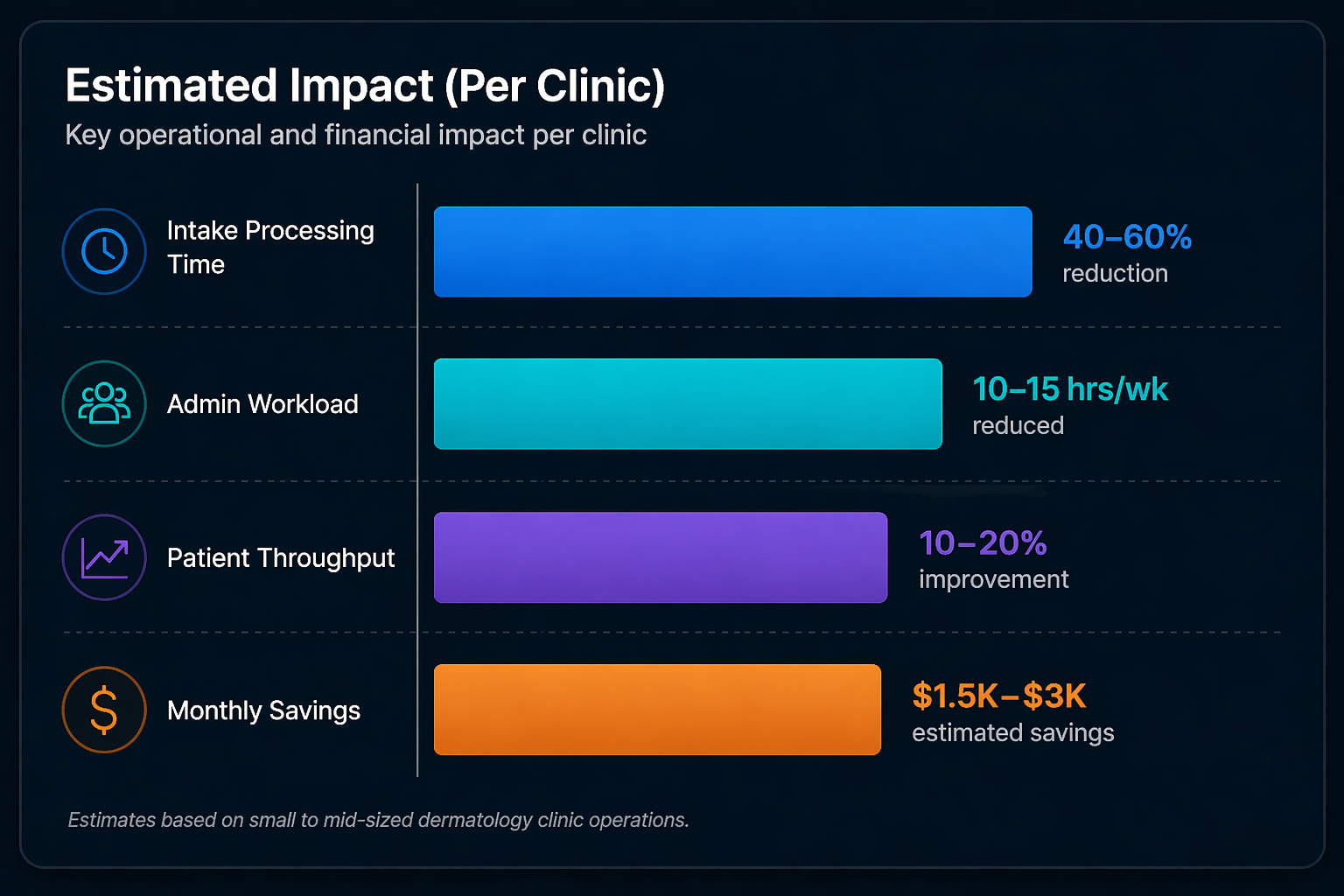
Operational efficiency gains and cost savings per clinic engagement.
Estimated revenue contribution across pipeline stages.
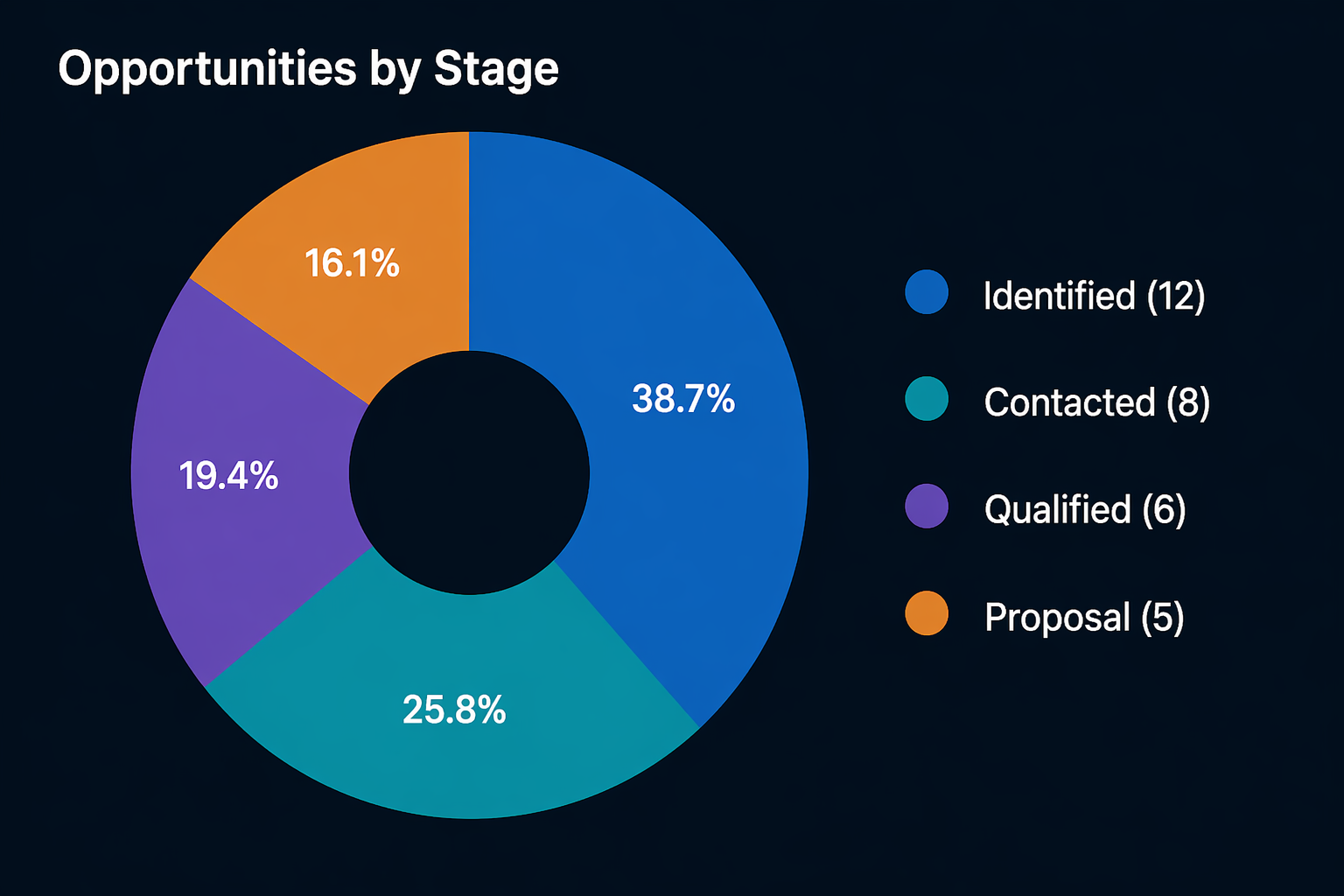
Distribution of outreach opportunities across qualification stages.
Execution evidence
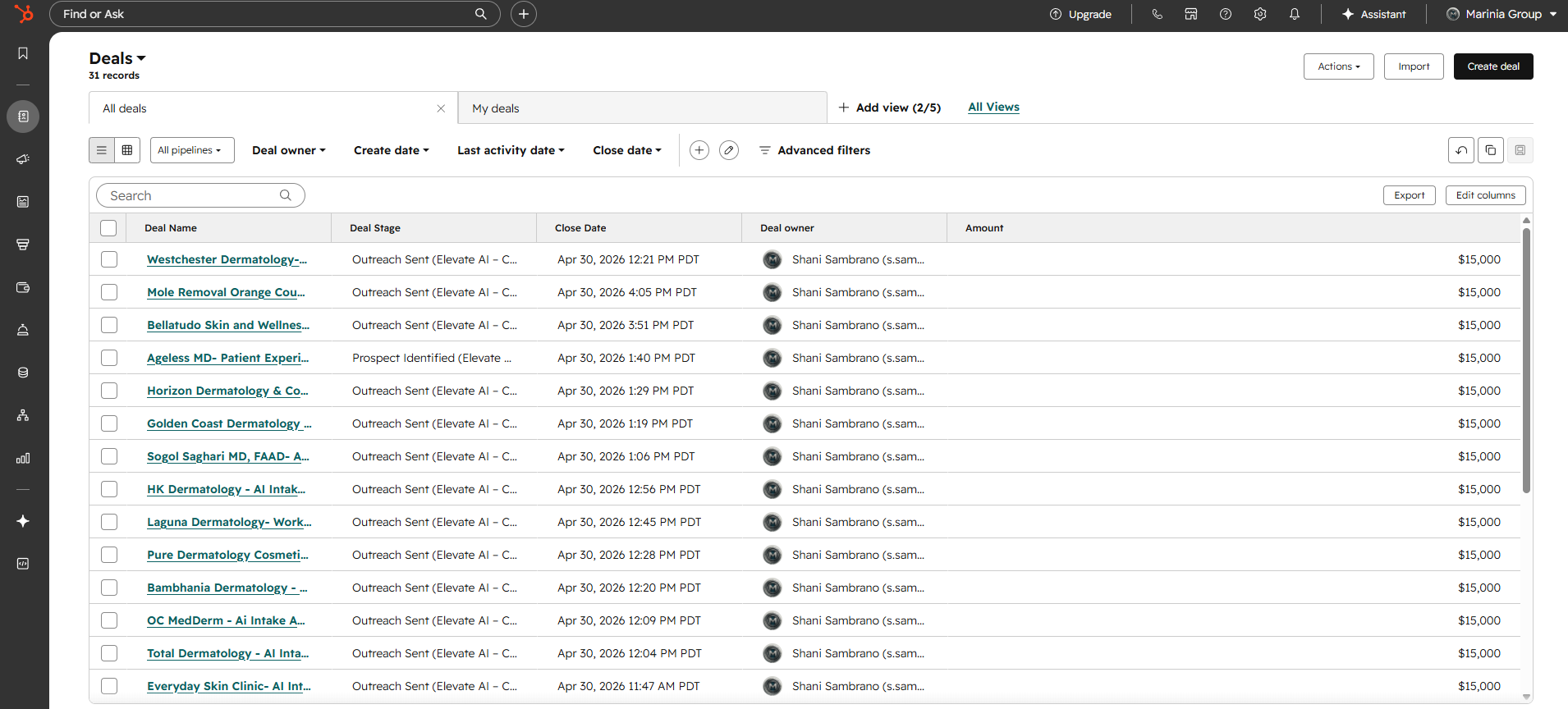
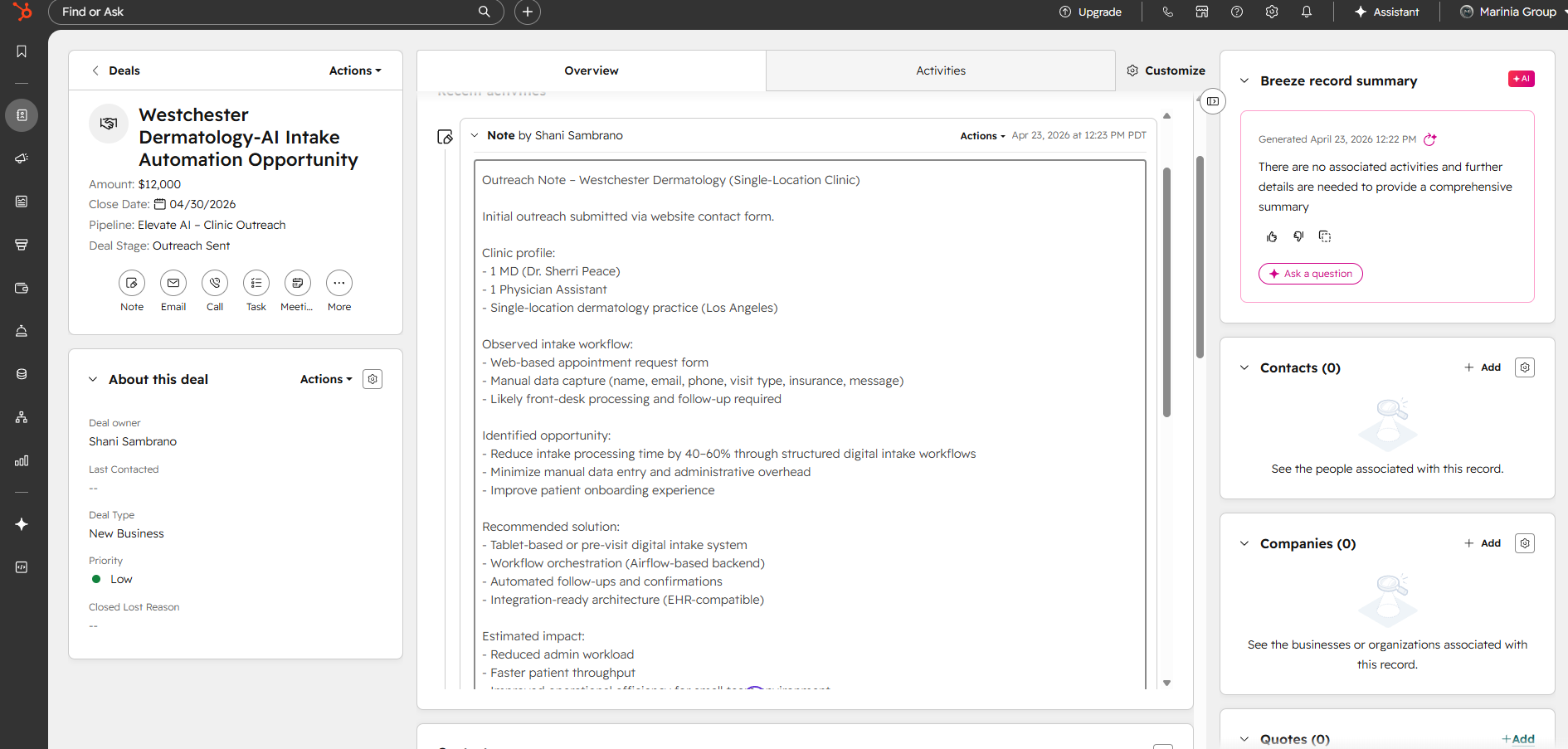
These artifacts document how the outreach system was structured in HubSpot and how an individual clinic was assessed as an intake automation opportunity.
Strategic significance
This project demonstrates an approach that bridges business development, workflow analysis, cloud architecture, and data strategy. Rather than treating outreach as pure sales activity, the pipeline was structured as a discovery engine for identifying automation use cases with measurable ROI.
What this shows technically
- Ability to frame business pain points as data and workflow problems
- Cloud-native thinking using AWS storage and modular system design
- Orchestration-first mindset using Airflow as an operational backbone
- Readiness to connect CRM data, automation workflows, and analytics
What this shows strategically
- Executive-level ROI framing for operational modernization
- Pipeline design that supports repeatable outreach and prioritization
- Industry-specific positioning for healthcare workflow transformation
- Practical consulting mindset: diagnose, quantify, architect, and communicate
Portfolio takeaway
This case study is a proof-of-capability artifact showing how a clinic outreach initiative can be elevated into a structured workflow automation opportunity. It reflects the ability to identify inefficiency, estimate business value, document technical direction, and organize evidence in a cloud-hosted portfolio.
In a production environment, the next phase would include a deployed intake form, an orchestrated backend workflow, CRM/EHR integrations, and a Power BI dashboard for conversion and operations monitoring.